






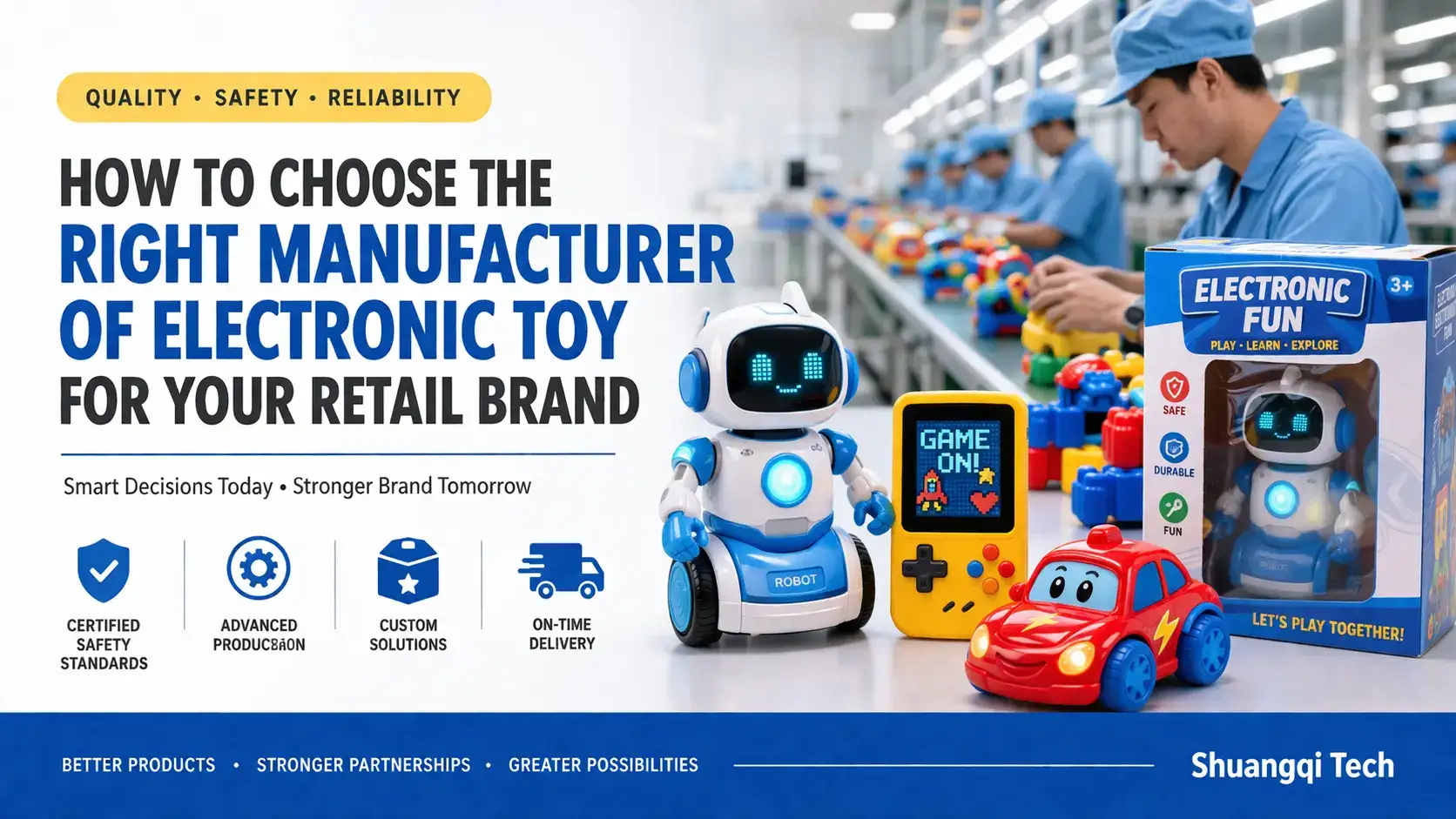
Choosing a reliable electronic toy manufacturer is one of the most important steps for any retail brand that wants to grow in the toy market in a stable and long term way. The quality of products, safety standards, and production capacity all depend heavily on this decision. A wrong choice can lead to product returns, safety issues, and loss of customer trust, which directly affects brand reputation and future sales.
In today’s global toy market, retailers need strong production partners who clearly understand both manufacturing processes and changing consumer demand patterns. A good manufacturing partner supports design development, quality control systems, and timely delivery schedules without compromising consistency. Many retail brands prefer suppliers who can manage large scale orders while maintaining stable quality across all batches. One such company working in this space is Shuangqi Tech which focuses on modern toy production systems and retail supply needs with structured processes.
This guide will explain step by step how to choose the right partner for your toy business in a practical way. It will help you understand quality checks, production capacity, safety rules, pricing structure, and communication methods so you can make a more informed and reliable sourcing decision for your retail brand growth.
A toy manufacturing partner is not just a simple production factory because it works as a complete system that converts product ideas into real physical toys ready for retail markets. Electronic toys require more attention because they contain batteries, electronic circuits, sensors, and sometimes wireless modules that must work safely and consistently.
A strong manufacturing partner manages several production stages at the same time including product design support, raw material selection, assembly processes, testing procedures, and final packaging systems. Retail brands depend heavily on this complete system because it ensures product consistency, safety, and market readiness across every production cycle without major variations.
When a manufacturer understands retail market demand properly, it becomes much easier to develop successful products that match customer expectations. They know what types of toys perform better in different seasons, regions, and age groups, which reduces product failure risk and improves sales potential for retail brands significantly in competitive markets.
Quality is always the first and most important factor that any retail brand should evaluate before selecting a manufacturer for electronic toys. These toys must be safe, durable, and stable in performance because they are directly used by children and any failure can damage trust and brand reputation very quickly.
A good manufacturer follows strict internal quality testing procedures before any product is shipped to the market. These tests usually include drop testing, battery safety testing, button durability checks, and electronic performance verification under different usage conditions. Every component is carefully inspected before final assembly to reduce defect risks.
Retail brands should also ask in detail about raw material sourcing because safe plastic materials, non-toxic paint, and certified electronic components are necessary for child safety standards. If low quality materials are used during production, the final toy will also fail in real market conditions and can lead to serious safety concerns.
Consistency is also an important part of quality control because one production batch must match the next batch in both appearance and performance. A stable manufacturing system always ensures that product design, functionality, and finishing remain uniform across all bulk orders without unexpected variation.
Safety compliance is one of the most critical requirements in the electronic toy industry because products are often sold in different countries with strict regulatory systems. A professional manufacturer always follows internationally accepted safety standards to make sure products can enter global markets without legal or technical issues.
Some commonly recognized safety standards include EN71 for European markets and ASTM standards for the United States market. These certifications cover mechanical safety, chemical safety, and electrical safety testing to ensure that toys are safe for children in real usage environments.
Manufacturers must also focus strongly on battery safety systems in electronic toys because improper design can lead to overheating, leakage, or circuit failure. Proper insulation, stable circuit design, and protective components are necessary to avoid such risks during long term usage.
Retail brands should always request valid compliance certificates before placing bulk orders because these documents confirm that products meet international safety requirements. This step also helps smooth customs clearance and reduces risks during global distribution and retail selling processes.
Production capacity defines the maximum number of units a manufacturer can produce within a specific time period, and it plays a very important role for retail brands that deal with seasonal demand fluctuations. Many toy products experience high demand during holidays and special sales seasons.
A strong factory setup is able to handle both small trial orders and large bulk production without delays or quality issues. This requires multiple production lines, trained technical staff, and a well organized electronic assembly system that can operate efficiently under pressure.
Scalability is equally important because when a toy product becomes successful in the market, demand can increase very quickly. If the manufacturer cannot scale production in time, retail brands may lose market opportunities and customer interest due to product shortages.
Before finalizing any supplier, retail brands should always ask about monthly production capacity, peak season output planning, and ability to increase production without affecting quality control systems or delivery timelines in urgent situations.
Retail brands often need unique product designs to stand out in the competitive toy market, and this is where customization support becomes extremely important in electronic toy manufacturing. Customization allows brands to create identity and differentiate products from competitors.
A good manufacturer provides both OEM and ODM services where OEM means production based on client provided designs, while ODM means developing new product designs with factory level technical support and engineering input from experienced teams.
Customization options can include changes in toy colors, sound effects, electronic features, packaging design, and sometimes even full product structure modifications. Strong development teams are able to convert product ideas into working prototypes for testing before full scale production begins.
Product development support also includes sample testing phases where retail brands can evaluate product performance, durability, and design accuracy. This step reduces production errors and ensures final products match expected quality standards in real market conditions.
Pricing plays an important role in supplier selection because retail brands need to balance product cost with quality and market competitiveness. The final price of electronic toys usually depends on material cost, electronic components, design complexity, and total order volume.
Low price offers can sometimes be attractive, but extremely cheap pricing often indicates reduced material quality or weaker safety standards. A balanced pricing model is always more reliable because it ensures both product safety and long term business stability.
Minimum Order Quantity or MOQ is another key factor that retail brands must understand clearly before placing orders. Some manufacturers require high MOQ while others offer flexible small batch production options depending on business size and product testing needs.
In the wholesale electronic toy market, flexible MOQ is especially important because retailers often prefer testing new products in smaller quantities before committing to large scale repeat orders based on market response.
Clear communication is a core requirement in successful manufacturing partnerships because it helps prevent misunderstandings and production errors. A good manufacturer always provides regular updates during every stage of the production process from sampling to final shipment.
Retail brands should also observe how quickly suppliers respond to inquiries and how clearly they explain technical production details. Slow or unclear communication often results in delays, design errors, or incorrect product specifications during manufacturing cycles.
Transparency in cost structure is equally important because reliable manufacturers clearly explain material costs, labor charges, packaging expenses, and other related production factors without hidden charges or unclear pricing breakdowns.
Strong communication and transparency together build long term trust between manufacturers and retail brands, which is essential for consistent business growth and stable product supply over time in competitive markets.
Sample testing is one of the most important steps before placing any large scale order because it allows retail brands to physically evaluate product quality, design accuracy, and overall performance before committing to mass production.
Retail brands should always test samples under real usage conditions to understand battery performance, electronic response, durability, and user experience. This practical testing helps identify potential issues that may not appear in initial product specifications.
If any problem is found during sample testing, it should be fixed and rechecked before starting bulk production because ignoring sample issues can lead to major financial loss and customer dissatisfaction in final product distribution.
Manufacturers who provide fast and accurate sample development usually have stronger engineering and production systems that support efficient product development and reliable mass manufacturing processes.
Factory inspection is an important step that helps retail brands verify real production capability before building long term partnerships with manufacturers. It gives a clear understanding of how production systems are managed on the ground level.
During inspection, brands should carefully observe machinery condition, worker skills, production workflow, and internal quality control systems. Clean, organized, and well managed factories usually produce more consistent and higher quality products.
Quality control departments inside the factory must also be active and properly structured because regular inspections during production help reduce defects and maintain uniform quality across large batches of electronic toys.
Some retail brands also use third party inspection services to get an independent evaluation of production quality which adds an extra layer of safety and confidence before shipment approval.
Packaging is an important part of retail success because attractive packaging design directly influences customer buying decisions and improves product visibility on store shelves in competitive retail environments.
A good manufacturer provides full packaging customization support including box design, brand labeling, safety instructions, and visual presentation that aligns with retail brand identity and target market expectations.
Electronic toys also require clear instruction manuals on packaging because customers need to understand how to use the product safely and correctly without confusion or operational difficulty.
Strong packaging support helps retail brands build better shelf presence, improve customer attraction, and increase product value perception in both online and offline retail channels.
Timely delivery is extremely important for retail brands because toy products often follow seasonal demand patterns where missing a selling season can lead to significant revenue loss and reduced market opportunities.
A reliable manufacturer works with experienced logistics partners to manage shipping schedules, export documentation, and international delivery processes in a structured and organized way.
Delays in logistics can directly affect retail performance and customer satisfaction, which is why proper supply chain planning is essential for maintaining consistent product availability in different markets.
Some manufacturers also provide shipment tracking systems so retail brands can monitor delivery status and plan inventory management more effectively in advance.
Many retail brands make avoidable mistakes during supplier selection which later create problems in product quality, supply chain stability, and overall business performance in competitive markets.
One major mistake is focusing only on low pricing because cheaper products often come with reduced quality standards that can lead to customer complaints and damage brand reputation over time.
Another common mistake is skipping sample testing which removes the opportunity to evaluate real product performance before committing to bulk production and large financial investment.
Poor communication management is also a frequent issue because unclear instructions or delayed responses often lead to production errors, delays, and mismatched product specifications during manufacturing cycles.
Choosing the right manufacturing partner is a long term strategic decision for any retail brand working in the electronic toy industry because it directly affects product quality, customer trust, and overall business growth potential in competitive markets.
Retail brands must carefully evaluate quality control systems, production capacity, safety compliance, communication strength, and development support before finalizing any supplier partnership for stable business operations.
Every step in the selection process plays an important role in reducing risks and improving product success rate in the retail market where competition is high and customer expectations are constantly increasing.
A strong supply chain always starts with the right manufacturing decision because product success depends heavily on production quality, safety standards, and timely delivery performance in real market conditions.
If you are planning to grow your toy business and want a stable production partner, choosing the right manufacturing team can make a major difference in long term success and market stability. Shuangqi Tech provides structured production support, consistent quality systems, and reliable supply solutions for electronic toy product lines that help retail brands grow with confidence.
Connect with a trusted electronic toy manufacturing partner today and take a strong step toward building a more stable, scalable, and successful toy brand in the global retail market.
A remote contro
READ FULLBuyers sourcing remote control light bulbs
READ FULLA touch control desk lamp replac
READ FULL