






Finding the right manufacturer for your electronic products is one of the most important steps in turning your idea into a real business. A reliable manufacturer does more than just build gadgets. They produce your product with high quality, save you money, and make sure everything arrives on time. Many business owners make a big mistake at the start. They choose the first factory they find on the internet. This often leads to long delays, bad quality, or even legal trouble. In 2026, the electronics market moves very fast because of new AI chips and smart sensors. You need a partner who knows how to handle these modern parts.
This guide will show you how to find and select the best partner for your hardware. You will learn every step, from doing your first research to checking a factory's history. We will compare making products in your own country versus making them overseas. You will also learn how to place your first order and manage problems in the supply chain. By the end of this article, you will have a clear roadmap. You will be able to make smart choices and build a long-term relationship with your manufacturing partner. This path helps you avoid risks and ensures your electronic product is a success in the global market.
A reliable manufacturer is like a partner for your business. When you have a good factory, you can focus on the things you do best. You can spend your time on design, innovation, and marketing. Outsourcing your production to a professional company has many benefits.
However, choosing the wrong manufacturer creates big risks. If a factory has a weak supply chain, your product launch will be late. If the quality is poor, customers will return the products and your brand reputation will suffer. Also, you might face legal issues if the factory does not follow industrial standards or environmental rules.
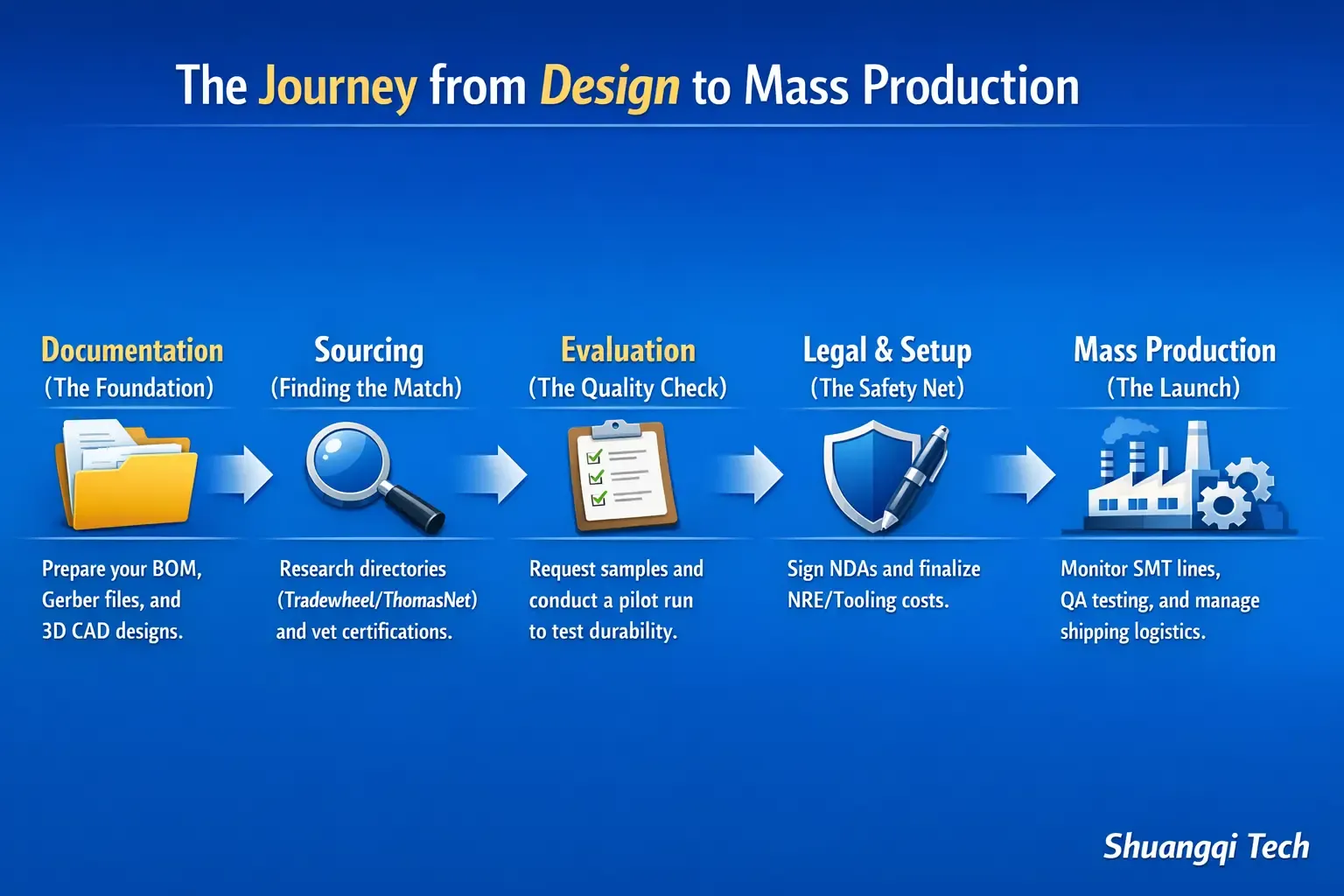
You must know what you need before you talk to any factory. If you are not clear, the manufacturer cannot give you an accurate price.
Electronics is a wide field. You must decide what specific service you need. Do you only need PCB Assembly (PCBA)? Or do you need a Box Build, where the factory puts the board into a plastic case and packs it in a box? Some factories only do cable harnesses or sensors. Make sure the factory matches your product type.
Are you making 50 units for testing or 50,000 units for a global launch? Some big manufacturers will not talk to you if your order is small. These are called Minimum Order Quantities (MOQ). Small factories are better for prototypes, while large factories are better for mass production.
You need a folder with all your technical data. This includes:
Depending on where you sell your product, you need specific stamps of approval.
Finding a list of factories is easy, but finding the right one takes work. You should use several different methods to find candidates.
Directories are the best place to start. Websites like ThomasNet, MFG.com, Kompass, and Alibaba list thousands of manufacturers. You can filter your search by location or certification. For example, you can search for "ISO 9001 certified PCB assembly" to get a clean list of qualified partners.
Go to Google and use specific terms. Do not just search for "electronics factory." Use professional terms like:
Use these keywords to find both domestic and international options.
Trade shows like CES in Las Vegas or Electronica in Germany are very helpful. You can meet factory owners in person. You can touch the products they have made for other clients. This helps you judge their quality much faster than looking at photos online.
If you want a manufacturer in the USA, use the North American Industry Classification System (NAICS) codes. For electronic products, the code is often 334418. You can use this number in business databases to find every registered factory in your area.
Once you have a list, you must check if they are telling the truth. This process is called vetting.
Ask the factory how long they have been in business. A company with ten years of experience is usually safer than a new one. Look at their portfolio. Have they made products similar to yours? If you are making a medical device, do not choose a factory that only makes toy cars.
Do not just take their word for it. Ask for copies of their certificates. Check the dates to make sure they are still valid. A factory that follows environmental rules is less likely to be shut down by the government.
This is a non-negotiable step. Ask the manufacturer to send you samples of their previous work. Check the soldering on the circuit boards. Is it clean? Does the plastic case feel solid? If the samples are bad, the final product will also be bad.
Check what machines they use. Do they have Automated Optical Inspection (AOI)? Do they offer In-Circuit Testing (ICT)? Modern electronics need modern testing. If a factory does everything by hand, the chance of mistakes is very high.
This is a big decision for every hardware startup. Both options have good and bad points.
|
Factor |
Domestic (Local) |
Overseas (International) |
|
Labor Cost |
High (Often $20+ per hour) |
Low (Around $4-$6 per hour) |
|
Communication |
Very easy, same time zone |
Can be hard, language barriers |
|
Shipping Speed |
Fast (Days) |
Slow (Weeks or Months) |
|
Quality Control |
You can visit the factory easily |
Hard to monitor in person |
|
IP Protection |
Strong legal system |
Higher risk of design theft |
If you have a complex product that needs many changes, stay domestic. If your design is finished and you need to save money on thousands of units, go overseas to countries like China, Vietnam, or Mexico.
When you have 3 to 5 good candidates, ask them for a formal quote. This is called a Request for Quote (RFQ).
Ask for a breakdown of costs. You need to see the price for parts (BOM cost), the price for assembly, and the price for testing. Also, ask about NRE (Non-Recurring Engineering) charges. These are one-time fees for setting up the production line.
Do not just negotiate the price. Negotiate the Minimum Order Quantity (MOQ) and the payment terms. For example, you might pay 30% at the start and 70% after the products pass inspection. Always ask them to sign an NDA (Non-Disclosure Agreement) before you send your final designs.
Compare all the data you have collected. Do not just pick the cheapest factory. Look at the "Total Cost of Ownership." A cheap factory might have a 10% defect rate. A slightly more expensive factory might have a 1% defect rate. The more expensive factory is actually cheaper because you will have fewer unhappy customers.
Choose a manufacturer that communicates clearly. If they answer your questions quickly during the sales process, they will likely be a better partner during production. Keep a "Plan B" manufacturer on your list just in case something goes wrong with your first choice.
Your first order should be a small batch. This is often called a "Pilot Run." It helps you find problems before you make thousands of units.
Ask the factory for updates at different stages:
If you are working overseas, consider hiring a third-party inspection company. They can go to the factory and check the goods before they are shipped to you.
In 2026, the supply chain is still a challenge for electronic items. Parts can suddenly become unavailable.
Work with a manufacturer that has a global network of vendors. They should be able to find alternative parts if one chip is out of stock. You should also keep a "buffer stock" of critical components in your warehouse.
Talk to your manufacturer every week. If there is a delay in shipping or a shortage of materials, you need to know immediately. Fast communication helps you adjust your marketing and sales plans.
A good relationship with your manufacturer is a secret weapon. When a factory trusts you, they will give you better prices. They might even move your order to the front of the line during busy times.
Finding the right manufacturer for your electronic products is a long process that requires focus and detail. You cannot rush this step if you want a successful business. Start by defining exactly what your product needs. Research potential partners using directories like Tradewheel and ThomasNet. Vet every candidate by checking their certifications, experience, and samples.
Compare the costs and benefits of domestic and overseas production. Once you pick a partner, protect your idea with an NDA and start with a small order. Monitor every step of the production to catch mistakes early. Managing your supply chain and building a strong relationship with your factory will help you stay ahead of the competition. If you follow these steps, you will transform your electronic design into a high-quality product that customers love. This systematic approach reduces your risk and builds a solid foundation for your brand’s future.
Finding the right manufacturer for your electronic products is hard, but partnering with an expert makes it simple. At Shuangqi Tech, we specialize in high-quality Electronic Manufacturing Services (EMS) tailored to your specific needs. From advanced PCB Assembly (PCBA) to complete Box Build solutions, we ensure your electronic products meet global standards like ISO and RoHS.
Why choose Shuangqi Tech? We offer state-of-the-art SMT production lines and transparent component sourcing for all your electronic products. Our team provides rigorous QA testing and dedicated support for both prototyping and mass production to ensure your electronic products are market-ready. Please contact us today to get a free manufacturing quote for your next project.
A remote contro
READ FULLBuyers sourcing remote control light bulbs
READ FULLA touch control desk lamp replac
READ FULL